

Alfred Russel Wallace, the renowned British naturalist, once sent a package of land snails collected from Bacan Island to his colleague Hugh Cuming in England. Wallace stayed on Bacan Island from October 1858 to April 1859, and his collection later appeared in an 1861 publication that documented 47 new land snail species.
Over 160 years later, in 2022, Indonesian researcher Ayu Savitri Nurinsiyah from the Research Center for Biosystematics and Evolution (BRIN) led an expedition to revisit Bacan Island’s land snails. The research team collected 555 specimens, representing 27 different land snail species.
New Discoveries from the 2022 Land Snail Expedition
By cross-referencing existing specimen collections and scientific literature until 2024, the team identified nine new distribution records and even described a completely new species of land snail.
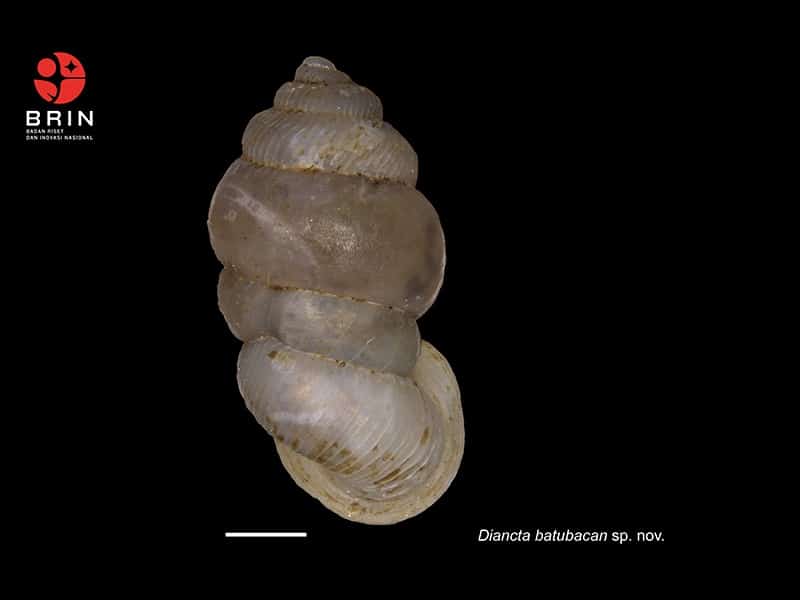
This new species has been named Diancta batubacan, a tribute to Batu Bacan, the famous chrysocolla gemstone native to Bacan Island.
“This discovery highlights Bacan Island as a vital refuge for Indonesia’s biodiversity. Much of it remains unexplored and holds great potential,” said Ayu in a BRIN release dated April 29, 2025.
With this addition, Bacan Island now hosts a total of 56 known land snail species, 13 of which are endemic, meaning they are found nowhere else in the world.
Ecological Role of Land Snails
Land snails play an essential ecological role. They contribute to plant matter decomposition and help disperse fungal spores, which in turn supports nutrient cycling and soil fertility. This rich, fertile soil sustains plant life and underpins the broader ecosystem.
Bacan Island: A Unique Ecosystem in Wallacea
Located in North Maluku, Bacan is one of the largest islands in the Wallacea region, a biogeographical transition zone between Asia and Australia. The island lies at the intersection of the Eurasian, Philippine Sea, and Australian tectonic plates.
Bacan is divided into two major ecological zones:
- Karst forests, with limestone formations
- Non-karst zones, including coastal and agricultural lands
This ecological diversity makes Bacan a hotspot of unique flora and fauna, including numerous endemic species.
Read more: Fish feed from palm cake as an alternative to fish meal
Habitat and Research Methodology
The 2022 research expedition took place between May and June. Researchers surveyed various habitats, from cacao plantations to karst forest slopes, collecting both living snails and empty shells found in leaf litter, under stones, and among decaying wood.
From 555 individual snails collected, researchers identified:
- 27 species
- From 11 different families
- 9 species recorded on Bacan for the first time
The team found the highest land snail diversity in karst forest areas, while population density peaked in non-karst forests. Interestingly, cacao plantations had the greatest population and diversity among cultivated landscapes.
“Our findings show that forest habitats support more individuals and more species (526 specimens and 27 species) than agricultural lands (29 specimens and 5 species),” stated the team in their 2025 paper published in ZooKeys.
Endemic and Vulnerable: Conservation Significance
The study underlined how land snails are sensitive indicators of environmental change, especially due to human disturbances. Their limited range and vulnerability to habitat loss make them excellent bioindicators.
“Micro-sized land snails are important indicators of habitat change and community structure,” the study noted.
Among Bacan’s 56 recorded species, most are concentrated in moist karst areas, showing a strong preference for specific ecological conditions.
Introducing Diancta batubacan: Bacan’s Newest Species
For the untrained eye, land snails may all look alike — aside from the familiar large Achatina or Giant African snail. However, to scientists, land snails display remarkable diversity. For example, the newly described Diancta batubacan differs clearly from the also pale-colored Sulfurina parva, another species found on Bacan.
D. batubacan is distinguished by its:
- Elongated shell
- Prominent second-to-last whorl
- 7 to 7.5 spirals
- Pointed apex
Further studies are needed to understand its behavior, diet, and reproduction, which remain undocumented.
Wallacea: A Cradle of Endemic Evolution
The Wallacea region is globally recognized for its extraordinary biodiversity and endemism. Its past isolation allowed unique species to evolve, many of which are not found in mainland Asia or Australia.
This makes Wallacea a natural laboratory for understanding:
- Biogeographic patterns
- Species distribution
- Evolutionary history
“This research not only enriches our knowledge of biodiversity, but also offers insights into species distribution in Wallacea,” Ayu explained.
Read more: Plasma Nano Bubble, A Technology That Can Restore Water Quality
Multidisciplinary Collaboration for Biodiversity
The Bacan expedition involved scientists from:
- BRIN (Indonesia’s National Research and Innovation Agency)
- Muhammadiyah University of North Maluku
- Mollusk Society of Indonesia
- University of Jember
- Padjadjaran University
Ayu and her colleagues previously discovered another new species on Moti Island, Maluku, named Palaina motiensis.
“There’s still so much hidden biodiversity in North Maluku and Wallacea. We must recognize and preserve Indonesia’s natural heritage — it’s a divine masterpiece that deserves protection,” Ayu concluded.
This remarkable discovery of Diancta batubacan reaffirms the ecological value of Bacan Island and the urgency of conservation efforts. As we uncover more of Wallacea’s treasures, one thing becomes clear: Indonesia’s biodiversity holds global significance, and we must act now to preserve it.
Join the Angphot community and learn modern farming while becoming a key player in climate mitigation through ANGPHOT Page. Explore the details on our page, and don’t miss out on our innovative agricultural products made from food waste management and hydroponics, along with creative works in the Angphot Catalog.

